
Dear Ayrshire Skincare Family,
The 10-Minute Lunch That’s Doing more for Your Skin than Your £40 Serum
Why this matters more for you specifically
HR is a high-cortisol job. And there are others where stress accelerates skin ageing just as quick — breaking down collagen faster and dulling that healthy glow, no matter how good your skincare routine is. A nutrient-dense lunch won’t fix a brutal quarter, but it gives your skin the raw materials to repair itself while you handle everything else.
You budget for everything else. Time it.
Between back-to-back meetings, headcount planning, and being the person everyone comes to with a problem, lunch is usually whatever’s fastest — a meal deal, a desk sandwich, something you barely taste. Understandable. But here’s the thing: what’s on your plate at 1pm is quietly writing the next chapter of what’s on your face at 40, 50, 60.
Skin is an organ. Feed it like one.
Your skin is your body’s largest organ, and it eats last — literally. Nutrients get rationed to vital organs first; skin gets what’s left over. So, if lunch is beige and empty, don’t be surprised when your skin looks tired too.
Colour isn’t decoration. It’s data.
Every colour on a salad plate signals a different nutrient doing a different job — and one ingredient earns its place on my plate more than most: Parsley.
Not a garnish. Not an afterthought scraped to the side of the plate. My salad carries a generous, finely chopped fistful of flat-leaf parsley — stalks and all — and there’s real science behind why.
Parsley is dense with polyphenols, plant compounds that survive digestion largely intact and travel down to the gut, where they act as food for your good bacteria. Research has linked these polyphenols to the growth of beneficial species, including Akkermansia muciniphila — a bacterium found in greater numbers in healthy guts, and one increasingly of interest to researchers for its role in gut-barrier strength and lowering inflammation. Less inflammation in the gut tends to mean less inflammation everywhere else, skin included. 
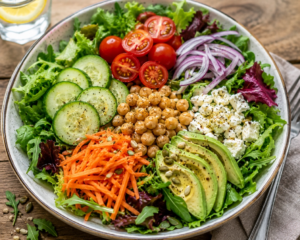
So that unassuming green pile isn’t there for colour balance. It’s doing quiet, unglamorous work — one chew at a time.
- Red (tomatoes, peppers) — lycopene, a natural defence against UV damage
- Orange (carrots, sweet potato) — beta-carotene, which your body converts to support skin repair and renewal
- Dark green (spinach, kale) — vitamins A, C and K, plus antioxidants that fight the free radicals behind fine lines
- Purple (red cabbage, beetroot) — anthocyanins, shown to calm inflammation and support collagen
- Yellow (sweetcorn, yellow pepper) — vitamin C, essential for collagen production — the protein that keeps skin firm
Five colours, five mechanisms, one plate. This isn’t wellness folklore — it’s basic biochemistry your dermatologist would nod along to.
Coming soon:
In my salad (headline photo), I also have red onion, pear and red pepper, together with the cooked (for five minutes) cherry tomatoes. I will write more about their health benefits in forthcoming articles
The ask
These foods are not a diet. Not a detox. They are foods for the body and the skin. So, just this once, today, why don’t you build a plate with at least four colours on it. That’s it. That’s the whole intervention.
Your skin already knows how to repair, renew, and glow — it’s just waiting for the ingredients to do it with. Have a think about it!!!
With our kindest regards
Jim and the team at Ayrshire Skincare Team
Shop online: https://ayrshireskincare.co.uk
Questions? We’d love to hear from you at reach@ayrshireskincare.co.uk